First Time Doing VR in Los Angeles? Here's What to Expect
So you have never tried VR. Maybe your friends keep raving about it. Maybe you saw a TikTok of someone flailing around in a headset and thought, "That looks ridiculous... but also kind of amazing." Or maybe you are looking for something to do in Los Angeles that does not involve sitting in traffic to get to another overpriced brunch.
Whatever brought you here, the good news is this: VR in 2026 is nothing like the clunky, nausea-inducing headsets you might have tried at a Best Buy demo five years ago. The technology has leaped forward, and Los Angeles happens to have one of the best collections of VR venues in the country. This guide will tell you exactly what to expect, how to prepare, and where to go for your first experience.
What Does VR Actually Feel Like?
The first ten seconds are the most disorienting, and also the most magical. You put on the headset, the screen flickers to life, and suddenly you are standing somewhere else entirely. Your brain knows you are in a room in Woodland Hills or Glendale, but your eyes and ears are telling you that you are on a space station, inside a haunted mansion, or standing on a cliff overlooking an alien landscape.
The sensation is difficult to describe to someone who has not experienced it. It is not like watching a 3D movie. It is not like playing a video game on a big TV. The closest comparison might be a vivid dream where you can look around in every direction and interact with things. When a zombie lunges at you, you will flinch. When you look down from a virtual skyscraper, your stomach will drop. Your brain genuinely struggles to separate "real" from "not real" in those first few moments.
Within a minute or two, most people settle in. You start to move more naturally, reach for virtual objects, and forget about the headset entirely. That is the sweet spot that keeps people coming back. First-timers almost always come out grinning, slightly sweaty, and immediately asking when they can go again.
Will I Get Motion Sick?
This is the number one concern for first-timers, and it is a fair one. VR motion sickness is real, but it is also far less common than most people expect, especially at professional venues that have specifically designed their experiences to minimize it.
Motion sickness in VR happens when your eyes see movement that your body does not feel. The good news is that most venue-based VR experiences are designed to avoid exactly this problem. Here is a rough breakdown of risk levels:
Low Motion Sickness Risk
- Free-roam VR (like Player One VR Santa Monica and Player One VR Glendale) — You physically walk around a real space, so your brain gets the movement signals it expects. This is the most comfortable type of VR for sensitive stomachs.
- Room-scale VR (like Sandbox VR) — You stand in one area and move within it. Most movement is natural body motion rather than artificial locomotion.
- Stationary puzzle games — Escape room-style VR where you are mostly standing still and interacting with objects in front of you.
Moderate Motion Sickness Risk
- Seated VR with movement — Racing games, roller coasters, and flight simulators. These can trigger discomfort because you see motion while sitting still. If you get carsick easily, start with something else.
- Fast-paced arcade VR — Some games at places like Los Virtuality or VR Hour involve rapid movement. Staff can point you to gentler options if you ask.
Pro tip: If you are worried about motion sickness, tell the staff at whatever venue you visit. Every VR venue in LA has dealt with this concern thousands of times, and they know exactly which experiences to recommend for sensitive players. Do not tough it out if you start feeling off. Take the headset off, get some air, and try a different game. There is no shame in it.
What Should I Wear?
This is one of those questions nobody thinks to ask until they are already in the parking lot. Here is what works best:
- Shoes: Wear closed-toe shoes with flat soles. Sneakers are perfect. Skip the heels, flip-flops, or platform shoes. You will be moving around, and you want stability.
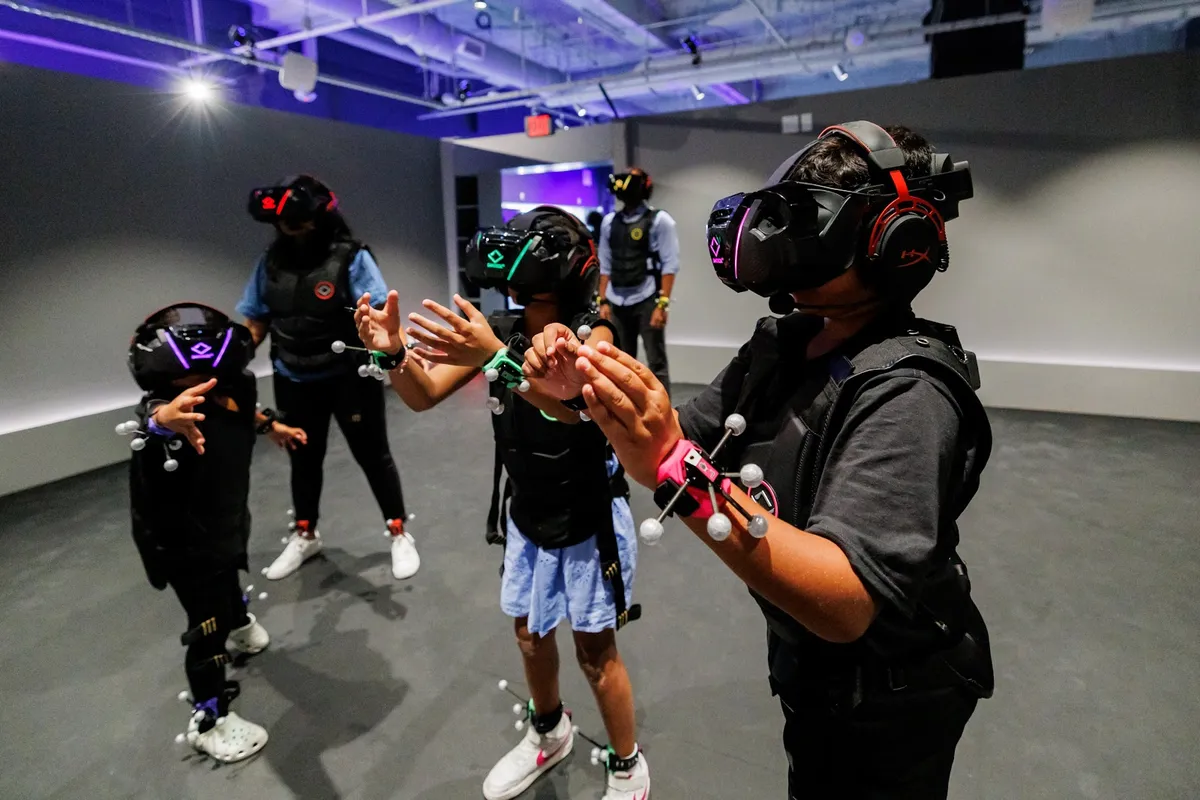
- Clothing: Dress like you are going to a casual gym session. T-shirts, joggers, or athletic wear are ideal. Avoid long flowing sleeves, scarves, or anything dangly that could get caught on equipment. Some premium venues like Sandbox VR use haptic vests that go over your clothes, so do not wear anything too bulky.
- Hair: If you have long hair, bring a hair tie. VR headsets have straps that go around and over your head, and loose hair can get tangled or make the headset fit poorly.
- Glasses: Most modern VR headsets accommodate glasses. If yours are very wide or have thick frames, you might want to try contact lenses instead, but most people are fine.
- Skip the heavy makeup: The headset presses against your face, and you will sweat. Foundation and eye makeup will transfer onto the foam padding. Most venues clean their headsets between sessions, but your makeup will not survive the experience either way.
Where Should a First-Timer Start?
Not all VR venues are created equal, and some are much better suited to first-timers than others. Here is how to think about it based on your budget and what kind of experience you want:
Budget-Friendly ($25-35 per person)
If you want to test the waters without a big commitment, these venues let you try VR at a lower price point with flexible time.
- Moonage VRcade — A dedicated VR arcade in the heart of Hollywood with a massive library of games. Staff will help you find the perfect starter experience, and the hourly pricing means you can play for as long (or as short) as you want. It is laid-back, friendly, and zero-pressure.
- VR Hour — Similar concept with pay-by-the-hour pricing. Great if you want to try multiple different games in one visit to figure out what kind of VR you enjoy most.
- THE CUBE VR Santa Monica or THE CUBE VR Glendale — Curated, immersive experiences designed to be accessible for all ages and experience levels. The staff guides you through everything, so you never feel lost or overwhelmed.
Premium Experience ($50-54 per person)
If you want your first VR experience to be genuinely unforgettable and you do not mind spending a bit more, these are the venues that deliver the "wow" factor.
- Sandbox VR (locations in Woodland Hills, Culver City, and Cerritos) — Full-body motion capture, haptic feedback vests, and Hollywood-quality storylines. You see your friends as full-body avatars inside the game. This is the experience that makes people say, "I had no idea VR was this good." Groups of 2-6.
- Player One VR Santa Monica or Player One VR Glendale — Free-roam VR where you physically walk around a large arena. No controllers needed for movement because you are actually walking. The lowest motion sickness risk of any format and an incredibly immersive first experience.
Full Entertainment Package
If you are not sure VR is your thing and want other activities as a backup plan, these venues combine VR with a broader entertainment experience.
- Two Bit Circus — A micro-amusement park in the Arts District with VR, classic arcade games, a full bar, and more. Perfect if you want VR to be part of a bigger night out rather than the whole evening.
- Battleground LA — A massive entertainment center with VR, laser tag, axe throwing, and more. VR is just one of many things you can do here, so it is great for groups where not everyone might be excited about VR.
How Long Does VR Last?
This depends entirely on the type of venue you visit. Here is a general breakdown:
| Venue Type | Active VR Time | Total Visit Time |
|---|---|---|
| Premium VR (Sandbox VR) | 30 minutes | 60-75 minutes (includes briefing, suiting up, and debrief/highlights) |
| Free-Roam VR (Player One VR) | 25-30 minutes per session | 45-60 minutes |
| VR Arcades (hourly pricing) | 1-2 hours (you choose) | 1-2+ hours |
| Immersive VR (THE CUBE VR) | 30-45 minutes | 45-60 minutes |
| Entertainment Centers | 15-30 minutes of VR | 2-4 hours (with other activities) |
For first-timers, 30 to 60 minutes of active VR is the sweet spot. Any longer and you might start to feel fatigue, especially in your arms if you are playing an action game. You can always come back for more once you know what you like.
Do I Need to Be Good at Video Games?
Absolutely not. This is one of the biggest misconceptions about VR, and it keeps way too many people from trying it.
VR is fundamentally different from traditional video games. There is no controller with 14 buttons to memorize. There is no complex combo system. In most VR experiences, you interact with the virtual world the same way you interact with the real one: you reach out and grab things, you point and shoot, you duck and dodge. If you can pick up a cup of coffee, you can play most VR games.
In fact, experienced gamers sometimes have a harder time adjusting to VR because they keep looking for buttons to press instead of just moving naturally. Non-gamers often pick it up faster because they do not have old habits to unlearn.
Staff at every VR venue in Los Angeles are trained to work with complete beginners. They will walk you through the controls, start you with something simple, and make sure you are comfortable before leaving you to it. You are not going to embarrass yourself. Everyone looked goofy their first time.
Common First-Timer Mistakes
After talking to staff at venues across LA and watching hundreds of first-timers, here are the mistakes that come up again and again:
- Not eating beforehand. An empty stomach plus VR movement can make you queasy. Eat a light meal about an hour before your session. Avoid heavy, greasy food.
- Choosing the most intense experience first. That zombie horror game looks incredible, but save it for your second visit. Start with something slower-paced to get your VR legs. Ask staff for their "best first-timer game" recommendation.
- Showing up without a reservation. Most premium VR venues in LA are reservation-only or strongly recommended. Walk-ins are sometimes possible at VR arcades, but weekend slots fill up fast. Book ahead, especially for groups.
- Wearing the wrong shoes. You would be surprised how many people show up in sandals or heels. Flat, closed-toe shoes every time.
- Fighting the experience. Some first-timers stand completely rigid because they are nervous. Relax. Lean into it. Look around. Reach out and touch things. The more you engage physically, the better the experience gets.
- Not telling staff about health concerns. If you have epilepsy, severe motion sickness, or any condition that might be affected by VR, mention it. Staff can adjust the experience or recommend alternatives. Every venue takes this seriously.
- Bringing too large of a group without planning. Most VR experiences cap at 4-6 people per session. If you have a group of 10, you will need multiple sessions or a venue that can accommodate larger parties. Call ahead.
The Bottom Line
VR in Los Angeles in 2026 is accessible, beginner-friendly, and genuinely impressive. Whether you spend $25 at a VR arcade or $54 at a premium venue like Sandbox VR, you are going to have an experience unlike anything else available in the city.
The best advice for a first-timer is simple: pick a venue from this guide, book a session, wear comfortable clothes and sneakers, eat a light meal beforehand, and tell the staff it is your first time. They will handle the rest.
You are going to love it. And yes, you are going to look a little silly in the headset. Everyone does. That is part of the fun.